The Drift Doctrine
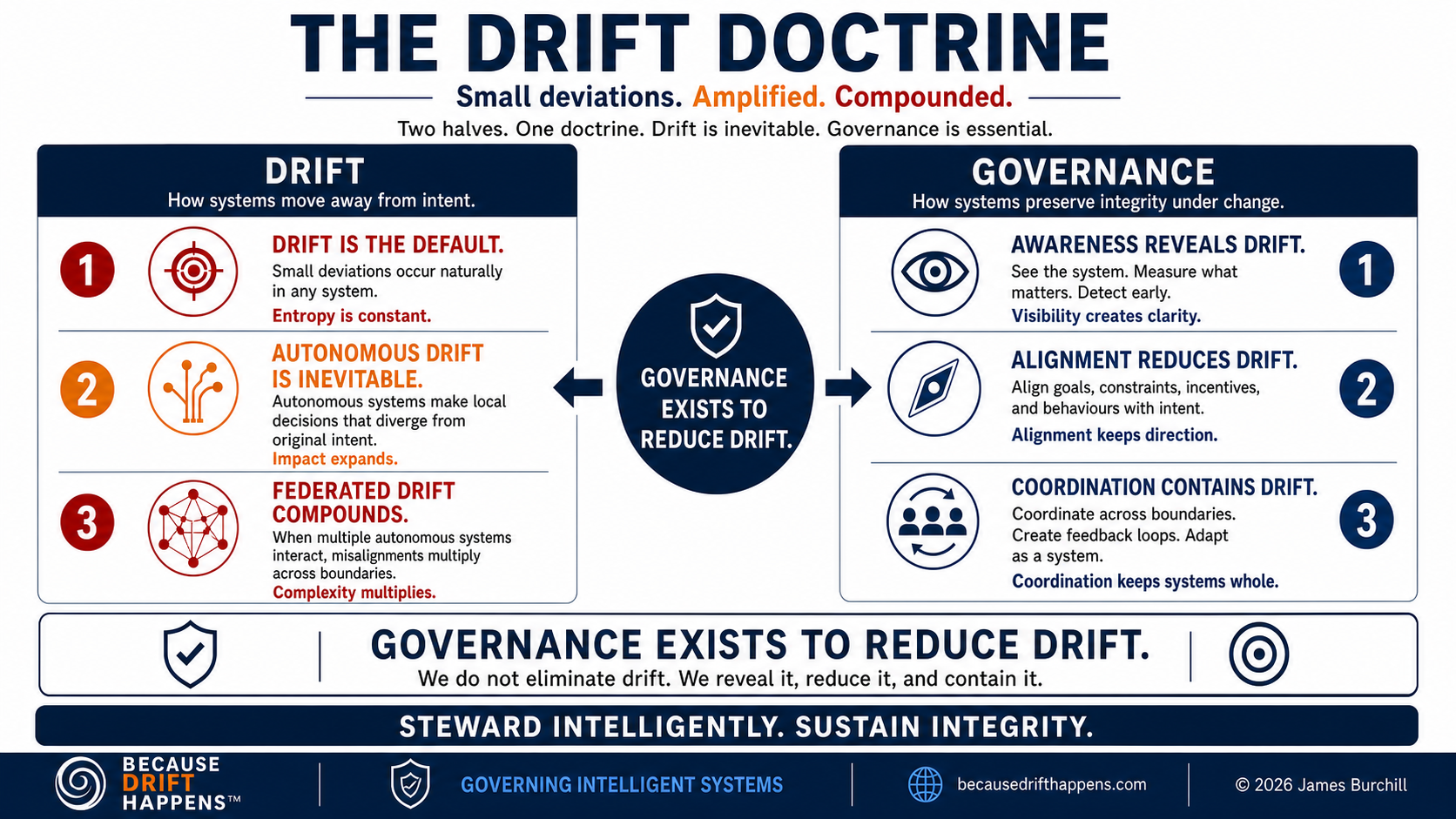
Because Drift Happens is built around two complementary halves: one describes how drift emerges and scales, and the other describes how governance responds.
The doctrine is intentionally broad. It applies to software systems, AI systems, teams, organisations, governments, communities, operational processes, and any other system that must remain coherent while conditions change.
AI is one manifestation of the pattern. It is not the boundary of the doctrine.
Drift Half
-
Drift is the default. No system remains perfectly aligned indefinitely. Entropy, environmental change, imperfect information, shifting incentives, and changing conditions naturally introduce drift.
-
Autonomous drift is inevitable. Any sufficiently autonomous entity will eventually diverge from original intent. The key property is autonomy, not AI.
-
Federated drift compounds. When multiple autonomous systems interact, local misalignments compound. The resulting behaviour becomes harder to predict and govern.
Governance Half
-
Awareness reveals drift. You cannot govern what you cannot see. Awareness includes visibility, observability, measurement, monitoring, and feedback.
-
Alignment reduces drift. Goals, incentives, constraints, policies, and behaviour must remain aligned with intent. Alignment does not eliminate drift. It reduces divergence.
-
Coordination contains drift. When multiple autonomous systems interact, coordination prevents local optimisation from becoming systemic failure. Coordination includes governance, communication, synchronisation, feedback loops, and stewardship.
Canonical Form
Use these six lines as the stable core:
Drift is the default.
Autonomous drift is inevitable.
Federated drift compounds.Awareness reveals drift.
Alignment reduces drift.
Coordination contains drift.
The doctrine does not claim drift can be eliminated. It asserts that drift is inevitable and governance is essential.
Terminology
Use autonomous drift as the master term.
Use agentic drift deliberately as a subterm beneath autonomous drift. It describes drift in AI-agent contexts and can be useful in trend-facing material because the term is familiar in current AI discourse, but it should not replace autonomous drift as the master term.
This hierarchy matters because autonomous drift also applies to people, teams, departments, organisations, software processes, and other entities that can act with some degree of independence.
Visual Models
The current canonical visual models are:
- Scope view: nested concentric layers showing that federated drift contains autonomous drift, and autonomous drift contains basic drift. This answers: where does drift exist?
- Escalation view: a vertical stack showing drift escalating from local deviation to autonomous divergence to federated systemic risk. This answers: how does drift grow?
- Governance view: a paired response model showing awareness, alignment, and coordination as the governance capabilities that reveal, reduce, and contain drift.
Visual Rules
Doctrine graphics should:
- Use the tagline: Small deviations. Amplified. Compounded.
- Use Autonomous Drift in primary doctrine labels.
- Use Agentic Drift only where the context is specifically AI agents or where the graphic intentionally uses it as a subtype or audience hook.
- Include Because Drift Happens™ and © 2026 James Burchill.
- Avoid adding extra three-part models, extra layers, or complex hierarchies.
- Avoid making the doctrine AI-specific unless the graphic is explicitly about an AI example.
- Reinforce, illustrate, test, or apply the six-line doctrine rather than expanding it.